Posts

40/M with chest pain and anxiety

Image
 40 year male from a neighbouring state arrived to our hospital today morning with complaints of retro-sternal chest pain and anxiety since 4 days. Pain was non radiating, crushing type which did not decrease on medication, aggravated on mild activity and was relieved with rest, not associated with palpitations or dyspnea. He had a history of fall ( miscalculated dive in a river and hit a stone) trauma to left temporal area 2 years back after which he had a dull headache in that region radiating to occipital lobe . CT scan was advised which showed extradural hemorrhage along right lobar temporal convexity, for which he came to Kamineni hospitals and was treated with T.PARACETAMOL and T.TEGRETOL for 3 months. His complaints subsided and he went back to his home.  After a lot of slow going passive questions, patient got homey and answered few personal questions. He stated there was nothing wrong with his sleep,appetite,bowel/bladder and daily routine. But then like most of the...
Image
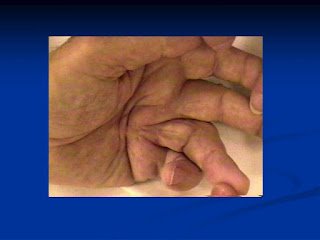
SPOTTER 1  Diagnosis? Management procedures?  SPOTTER 2 DIAGNOSIS? Management? SPOTTER 3 Diagnosis? Which age group most commonly affected? SPOTTER 4 Diagnosis? Explain the gait seen in this condition. SPOTTER 5 Name the condition? What are these spots called?  SPOTTER 6 What is this sign called as?In which two conditions is it seen? SPOTTER 7 This sign is seen in which condition? other clinical feautres seen in this condition SPOTTER 8  Name the condition and components of it.

25/F with generalised weakness and splenomegaly

Image
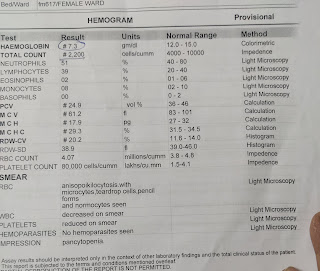
 25/F daily labourer by occupation came to gen medicine OP with complaints of pain abdomen (on and off) since 1 year, decreased appetite with early satiety since 1 year, hair loss since 1 year and generalised weakness ( on and off)  Pain abdomen is squeezing type, diffuse not associated with vomiting or nausea 12 years back she had trauma on right foot ( an iron material fell on it) followed by swelling of the foot and later whole body ( anasarca )  H/O blood transfusion (2 pints)  after 2-3 months of trauma ( hemoglobin 3.2 gm ) at that time. Injection iron sucrose 10 ampules  transfused on alternate days during her 8th month of 1st gestation (Hb then was 7 ). She had jaundice during the 9th month of her gestation During delivery emergency LSCS ( august 2019) done due to foetal distress and due to PPH, 2 pints of blood transfusion was done pallor +  distended abdomen. spleen palpable + ( upto umbilicus)  menstrual history:  Age of menarche -13 du...

BIMONTHLY January

Image
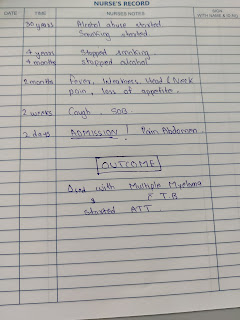
 1.26 year old woman with complaints of altered sensorium since day,headache since 8 days,fever and vomitings since 4 days  https://harikachindam7.blogspot.com/2020/12/26-year-old-female-with-complaints-of.html a). What is the problem representation of this patient and what is the anatomical localization for her current problem based on the clinical findings? A 28 year old woman with the complaints of Headache since 8 days Fever since 4 days Vomitings since 4 days Altered sensorium since 1 day 28 year old woman with 1. Hyponatremia secondary to SIADH 2. Tubercular meningitis 3. Acute infarct in the left thalamic region 4. SLE with multiple joint pains  b) What is the etiology of the current problem and how would you as a member of the treating team arrive at a diagnosis? Please chart out the sequence of events timeline between the manifestations of each of her problems and current outcomes.  2. Tubercular meningitis: Patient presenting in altered sensorium with Fever...

BIMONTHLY December

Image
 QUESTION NO 1) 1) pt presented vth unable to move his rt upperlimb followed by recurrent episodes of rt sided focal seziures. risk factors in him are alcoholic, smoker, diabetic,on presentation BP was high(170/100mmhg). According to h/o pt might be having cerebrovascular event follwed by focal seziures. Anatomical location could be ?frontal lobe involvement ( imp for cognitive functions and control of voluntary movements), ? parietal lobe (it processes information about movement) could be? anterior circulation stroke. 2) sub cortical infract - occur in the supplying area of a single, deep perforating brain artery and are mostly felt to be a consequence of cerebral small-vessel disease (CSVD). Cortical brain infarcts - infarcts involving cortical gray matter, but may differ considerably in size. ... Small cortical infarcts were mainly localized in external watershed areas, whereas large cortical infarcts were localized primarily in large arterial territories.  3) Cerebrovascu...

NOVEMBER BIMONTHLY EXAM

Image
  CASE 1 Question 1) pain in the epigastric region differentials Gastric ulcers Inferior wall MI Acute pancreatitis (Boaring kind of pain) 2)sob- acidosis due to renal failure          ? Ards secondary to sepsis/pancreatitis           Pleural effusion due to acute pancreatitis            3)decreased urine output-pre renal Aki secondary to volume loss(oliguric) 3rd space loss due to pancreatitis Sepsis induced aki 4) abdominal distention with constipation and nausea Secondary to paralytic ileus Treatment 1) Antibiotics  imipenem, ciprofloxacin, ofloxacin, ceftriaxone, cefotaxime, ceftizoxime, cefotiam, piperacillin, mezlozillin, metronidazole and tazobactam were detected in pancreatic tissue at concentrations exceeding the MICs of most of the relevant bacteria A first controlled clinical study with prophylactic imipenem in patients with severe acute pancreatitis showed a reduction in the rate of sep...

THESIS

 TOPIC: A STUDY ON ASSOCIATION BETWEEN ULTRASONOGRAPHIC VISCERAL FAT THICKNESS AND CARDIOVASCULAR RISK IN TYPE 2 DIABETES MELLITUS AND THEIR GLUCOSE CONTROL PROBLEM STATEMENT: 1] Currently  the  number  of  cases  of  diabetes  worldwide  is  estimated  to be  around  150  million.  India  leads  then  world  with  the  largest  number  of  diabetic subjects  earning  the  dubious  distinction  of  being  the  “diabetic  capital  of  the world”. Complications of diabetes can only be prevented by timely and regular glucose control that includes proper use of OHA's / insulin therapy / lifestyle modifications 2] Obesity  has  induced  many  public  health  problems  related  to diseases, including glucose intolerance, hypertension, hyperinsulinemia,  dyslipidemia  and...